Fraudulent IBAN sharing
A solution destined to Payment Service Providers, compliant with the requirements set forth by Labaronne Law (2025-1058) in France - with the FNC-RF, also anticipating the future requirements of the Payment Services Regulation (PSR).

A solution destined to Payment Service Providers, compliant with the requirements set forth by Labaronne Law (2025-1058) in France - with the FNC-RF, also anticipating the future requirements of the Payment Services Regulation (PSR).

France, through the Labaronne Law (2025-1058) dated November 6th, 2025, is very active on the topic of payment fraud, with the implementation of a national database operated by the Banque de France.
In Art. L. 521-6-1.-I. of the French Monetary and Financial Code, it is mentioned that “in order to improve the prevention, investigation, and detection of payment fraud, a national database records information enabling the identification of payment accounts and deposit accounts that payment service providers as defined in Article L. 521-1 of the French Monetary and Financial Code, established or operating in France – except for AISPs and PISPs – suspect to be potentially fraudulent, notably based on analyses carried out within the framework of their internal anti-fraud systems”.
This database, the FNC-RF, (Fichier National des Comptes signalés pour Risque de Fraude, standing for national file of accounts reported for fraud risk), leverages MISP (Malware Information Sharing Platform), initially built to prevent cyberthreats and more specifically to enable the exchange of key indicators.

Another Regulatory Milestone for Payment Service Providers
In France, since May 7th – and in the EU with PSR in the near future – financial institutions in scope (credit institutions, EMIs and PIs, with the exclusion of AISPs and PISPs) have to comply with Law Labaronne and connect to the FNC-RF to ensure the security of payments and decrease transactions fraud.
A French national database to reduce payment fraud.
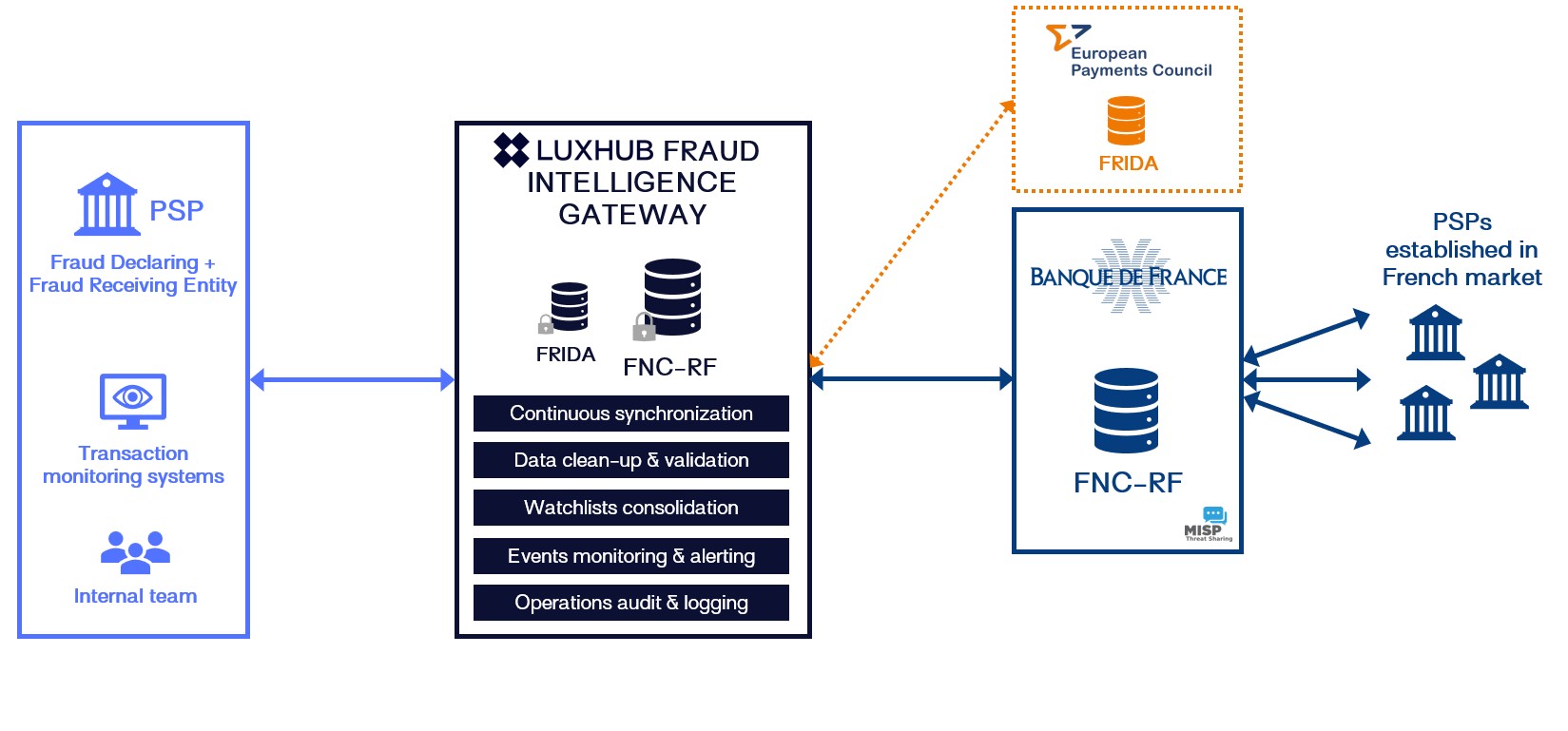
Fraud Intelligence Gateway
LUXHUB, a recognized partner of financial institutions, is providing a solution to PSPs established in France and/or operating in France, to facilitate the sharing of suspicious fraud events.
The Fraud Intelligence Gateway enables them to directly connect to the FNC-RF platform, managed by the Banque de France. It also powers PSPs with additional features (continuous synchronization, watchlists consolidation, events monitoring and alerting, etc.)
The solution consists of:
- Functional and technical onboarding with Banque de France (with two available environments)
- Business logic to refine and contextualize fraud data
- Convenient interfaces to import and share relevant data
- Granular user permissions and full traceability
- Can be integrated in VOP flows
get brochure

Paving the way for the upcoming Payment Service Regulation (PSR)
With PSR currently in the final trilogue phase, the regulation might be adopted in the months to come. The regulation will harmonize payment rules and obligations across the EU and will also aim to strengthen consumer protection and fight payment fraud.
The forthcoming Payment Services Regulation (PSR) will strengthen such rules and obligations. As stated in Article 83a (latest version), “PSPs shall participate in information sharing arrangements with other PSPs and shall exchange data to the extent necessary to comply with their obligation to prevent and detect potentially fraudulent payment transactions, where the PSP has objectively justified reasons to suspect fraudulent behavior by a PSU. The information sharing arrangements shall specify the details of participation and the details of operational elements, including the use of dedicated IT platforms. […]”
Moreover, the EPC (European Payments Council) launched, earlier this year, a request for information to identify organizations interested in providing, operating and supporting a Central Platform for its Fraud Information Distribution Arrangement (FRIDA) Scheme. As explained by the EPC, “FRIDA is designed to enable PSPs – and potentially other stakeholders – to exchange fraud information under common rules, standards and practices across Single Euro Payments Area (SEPA) and EPC schemes”.
The LUXHUB team is monitoring the latest progress, and will make sure that all upcoming provisions related to fraud can be rapidly implemented within its Fraud Intelligence Gateway.
Get in touch now
Interested in learning more about LUXHUB’s Fraud Intelligence Gateway to accelerate your compliance to French Law Labaronne?
Frequently Asked Questions
LUXHUB’s Fraud Intelligence Gateway is a compliance and connectivity solution designed for payment service providers (PSPs) established or operating in France. It enables PSPs to connect to the FNC-RF (Fichier National des Comptes signalés pour Risque de Fraude) the national fraud account database operated by the Banque de France. This new regulatory framework was introduced by the Labaronne Law (2025-1058) of 6 November 2025. The solution facilitates the secure sharing of suspicious IBAN to prevent and detect payment fraud.
The Labaronne Law (Loi 2025-1058), published on 6 November 2025, establishes a national French framework for combating payment fraud. Under Article L.521-6-1.-I. of the French Monetary and Financial Code, in-scope PSPs: credit institutions, EMIs, and payment institutions established or operating in France (excluding AISPs and PISPs) are required to report fraud events, and therefore the payment accounts they suspect of fraudulent activity, to the FNC-RF national database operated by the Banque de France. It entered into application on May 7th, 2026.
The FNC-RF (Fichier National des Comptes signalés pour Risque de Fraude) is a national French database of payment accounts suspected of fraudulent activity. It is operated and managed by the Banque de France. PSPs report fraud events to the FNC-RF, which then makes this information available to all participating institutions to inform their internal anti-fraud controls and take the appropriate decisions were these payments accounts held within their organization
In-scope institutions are payment service providers established in France or operating in France that fall within the definition of Article L.521-1 of the French Monetary and Financial Code. This includes credit institutions, electronic money institutions (EMIs), and payment institutions. Account Information Service Providers (AISPs) and Payment Initiation Service Providers (PISPs) are explicitly excluded from the scope of the Labaronne Law FNC-RF reporting obligation.
LUXHUB’s Fraud Intelligence Gateway provides PSPs with functional and technical onboarding support for both available Banque de France environments (test and production). The solution includes business logic to refine and contextualize fraud data before submission; convenient interfaces for importing and sharing relevant suspicious account information; continuous synchronization with the FNC-RF database; granular user-permission controls; full audit traceability; and event monitoring and alerting capabilities. It can also be integrated into VOP (Verification of Payee) flows.
LUXHUB has specifically designed its Fraud Intelligence Gateway to integrate with VOP (Verification of Payee) workflows. When a VOP check is performed, the Fraud Intelligence Gateway can cross-reference the beneficiary IBAN against watchlists consolidated from the FNC-RF and other fraud data sources, enriching the payee verification outcome with additional fraud risk signals. This integration provides PSPs with a more holistic fraud prevention layer across both their VOP compliance obligations and their FNC-RF reporting duties.
The EU Payment Services Regulation (PSR), will harmonize payment fraud information sharing rules across all EU member states. Article 83a of the PSR draft requires PSPs to participate in information sharing arrangements with other PSPs to prevent and detect fraudulent payment transactions. LUXHUB is actively monitoring PSR developments and has designed its Fraud Intelligence Gateway to be future-proofed for upcoming PSR obligations, enabling rapid expansion from French compliance to EU-wide fraud intelligence sharing.
FRIDA (Fraud Information Distribution Arrangement) is a scheme initiative launched by the European Payments Council (EPC) to create a Central Platform for pan-European payment fraud intelligence sharing among PSPs across the SEPA zone. The EPC published a request for information to identify organizations capable of operating this infrastructure. LUXHUB is monitoring FRIDA developments closely and will ensure its Fraud Intelligence Gateway can support FRIDA scheme participation as the platform matures alongside PSR adoption.
Currently, the Fraud Intelligence Gateway is primarily targeted at PSPs established in France or operating in France, in compliance with the Labaronne Law’s FNC-RF reporting requirements. However, LUXHUB is developing the solution with a European expansion strategy in mind, anticipating the upcoming PSR requirements for EU-wide fraud information sharing arrangements. PSPs outside France that want to prepare proactively for PSR obligations are encouraged to engage with LUXHUB now.
Key benefits include: ready-made compliance with Labaronne Law requirements from day one; streamlined onboarding with both Banque de France test and production environments; business logic to refine and contextualize fraud data for higher-quality submissions; integrated watchlist management and event alerting to strengthen internal fraud detection; full audit trail and granular user permissions for governance; compatibility with VOP flows for enhanced payment security; and future-readiness for PSR fraud information sharing requirements at the EU level.
By connecting PSPs to the shared FNC-RF database, the Fraud Intelligence Gateway enables institutions to benefit from collective intelligence across the French banking and payment ecosystem. When one PSP identifies a suspicious account and reports it to the FNC-RF, all other connected PSPs gain access to that fraud signal, enabling PSPs to take informed decisions with regards to these specific accounts. This mutualized, real-time intelligence sharing model is significantly more effective than individual institutions operating in isolation.
The Labaronne Law specifies that PSPs report accounts suspected of fraud ‘notably based on analyses carried out within the framework of their internal anti-fraud systems.’ This means PSPs need functioning internal fraud detection processes to identify potentially fraudulent accounts before reporting them to the FNC-RF. LUXHUB’s Fraud Intelligence Gateway provides the technical connectivity and data management layer for this reporting, complementing rather than replacing existing internal fraud risk management frameworks.
PSPs interested in implementing LUXHUB’s Fraud Intelligence Gateway can request information via the dedicated contact form or download the product brochure. The LUXHUB team will then get back to you to set up a meeting, discuss your current fraud reporting infrastructure, and propose an onboarding plan.