From innovation to maturity: Thibault de Barsy on the next chapter of European payments
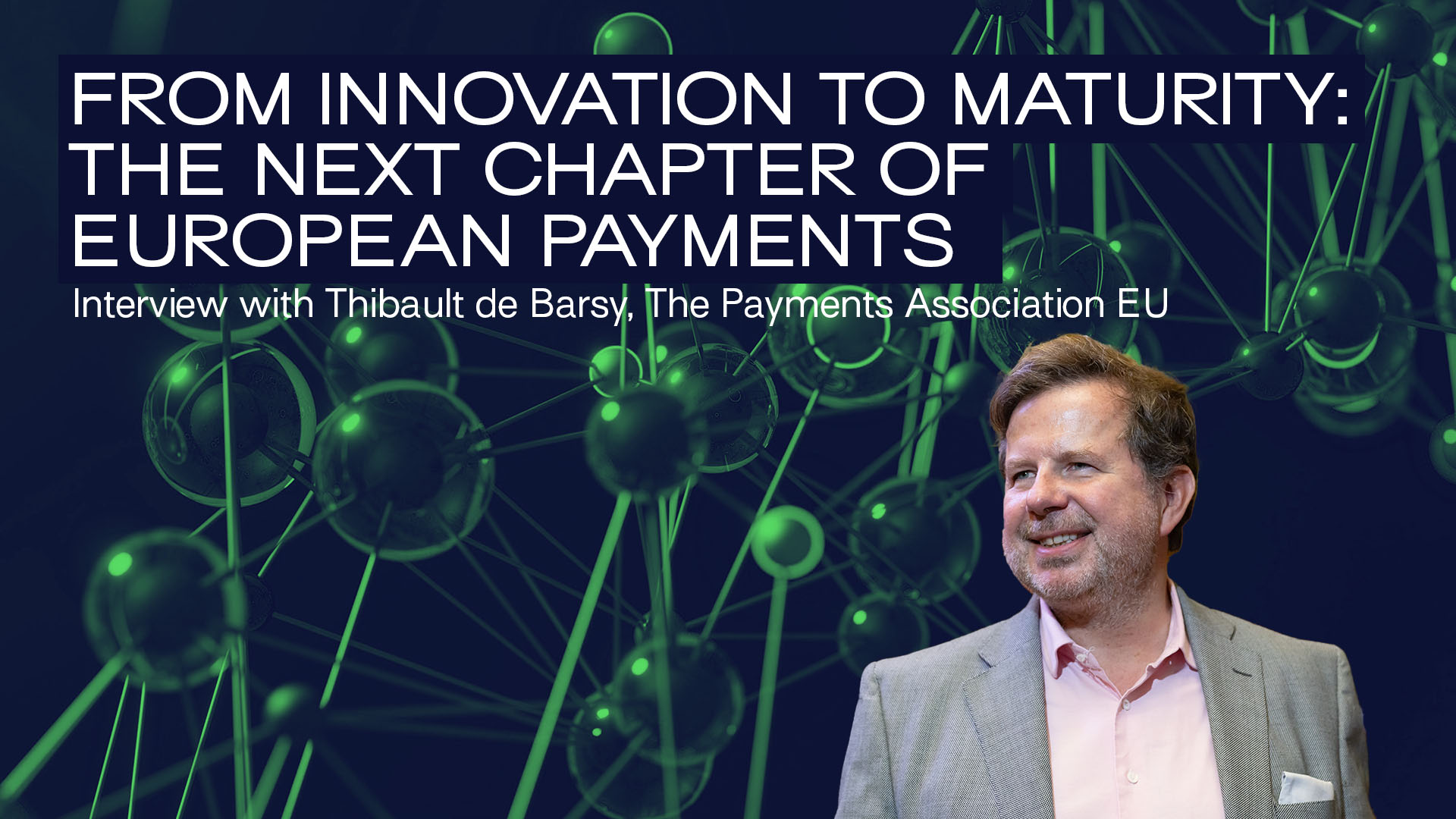
In five years, European payments have become more regulated, more professional and more European. Instant payments, Verification of Payee, DORA and MiCA have reshaped the rulebook, and PSD3 and the Payment Services Regulation are next. We spoke with Thibault de Barsy, General Manager of The Payments Association EU, about how the market has evolved, the compliance challenges faced by PSPs, and why fraud prevention is where industry collaboration matters most. He also previews Payments Tomorrow 2026, taking place in Paris on 15 October.
Thibault, can you tell us about your background and what led you to becoming General Manager of The Payments Association EU?
I’ve spent more than 25 years at the crossroads of finance, technology and marketing, working in Belgium, Luxembourg and Malaysia. I started in marketing and sales roles across banks, insurers, telcos and credit card companies. It gave me an early view of how payments look from very different sides of the value chain. I then spent five years as CEO of Keytrade Bank Luxembourg, where I led a digital-first bank at a time when customer expectations were changing fast.
When the idea of a European sister association to the UK’s Payments Association came up as a result of Brexit, it felt like a natural next step. Europe had a very dynamic payments industry but no neutral place where banks, PSPs, fintechs, schemes and regulators could simply sit together and talk business. I’ve been General Manager since the launch of The Payments Association EU, and helping build that community has been hugely rewarding. I also lecture at Solvay Brussels School of Economics and Management, which keeps me in touch with the next generation.
Is there a particular project that has shaped your view of the European market?
It’s our famous “Key Players in the EU” whitepaper, developed with Deloitte and The Paypers. We created this report to help our Members better understand and grow in the European market. It combines country-by-country strategic insights for every EU Member State with financial data from Moody’s Orbis, which makes it unique. The report has improved considerably with each edition, and the latest one has just been released. I would label it as essential reading for anyone doing business in European payments.
How would you describe the evolution of the European payments landscape over the last five years?
It has moved from innovation to maturity, and from national to European. Five years ago, the conversation was dominated by PSD2, the promise of open banking and a wave of well-funded fintechs. Since then, several things have changed.
First, regulation remains the main driver of change. Instant payments became mandatory, Verification of Payee is now live across the eurozone, DORA has raised the bar on operational resilience, and MiCA has created a framework for crypto-assets and stablecoins. Second, European sovereignty has become a strategic topic, with EPI Company and Wero on the private side and the digital euro on the public side. Third, the fintech market has matured. After the funding boom came a correction, and the focus shifted to profitability, licensing and sound governance. The industry today is more professional, more regulated and more European than it was in 2021.
Which trends do you expect to shape the next 18 months the most?
I see four. The first is the implementation of PSD3 and the Payment Services Regulation, which will reshape fraud liability, open banking and access to payment systems. The second is whether European account-to-account solutions can gain market share at the point of sale and in e-commerce. The third is new forms of money: the digital euro legislative process, euro stablecoins under MiCA, and tokenised deposits. The fourth is AI, both for fighting fraud and through the rise of “agentic commerce”.
What are the biggest regulatory compliance challenges PSPs are facing today?
The biggest challenge is not any single regulation. It’s the cumulative load. A mid-sized PSP is already managing DORA and will soon have to handle PSD3/PSR, the new AML package and, in some cases, MiCA, all at the same time and often with the same small compliance team.
Within that, fraud is the most pressing topic. The shift of liability towards PSPs for impersonation fraud will require real investment in monitoring and data sharing. Safeguarding and access to payment systems also remain important issues for non-bank PSPs. And there is still some fragmentation in how national authorities interpret the same European rules.
Where do you see the greatest opportunity for collaboration between industry players such as PSPs, Regtechs and regulators?
Fraud prevention, without hesitation. Fraudsters cooperate very efficiently across borders and across institutions, and the industry needs to do the same. The new framework makes fraud data sharing between PSPs possible, and this is where Regtechs and shared infrastructure providers can add a lot of value.
The second opportunity is dialogue with regulators before rules are finalized, not only after. This is exactly why we run our Regulatory Working Groups at the Association. They open a direct channel between our Members’ compliance officers and supervisors. When regulators understand operational reality and the industry understands policy intent, implementation is faster and cheaper for everyone.
Can you tell us more about the Association’s main missions?
The Payments Association EU is a business club for decision-makers in the payments industry. We’re based in Luxembourg and are the sister association of The Payments Association in London. Our Members come from every part of the payments value chain across the 27 EU member states: banks, PSPs, e-money institutions, schemes, technology providers, consultants and law firms.
Our mission is simple: to facilitate business for our members. We do that through events, from our PA@Home evenings to our annual conference, through research and white papers, through training and our Regulatory Working Groups. We are a place where the industry can meet, exchange and understand each other.
Which topics is the Association currently focusing on at European level?
Our agenda closely follows what keeps our Members awake at night: PSD3 and PSR, the digital euro, stablecoins and MiCA, open finance, DORA and operational resilience, cross-border payments, and the resilience of European payment infrastructures. We’re also paying close attention to fraud, and to how AI will change both the way payments are made and the way they are protected.
How does the Association work with players like LUXHUB to move these topics forward?
LUXHUB is a Member of the Association, and it is exactly the kind of Member that makes our community valuable. LUXHUB brings deep, hands-on expertise in regulatory compliance and payments infrastructure, and it sits at the heart of the Luxembourg ecosystem, which is one of Europe’s key hubs for payment and e-money institutions. Through our Regulatory Working Groups, events and publications, we give Members like LUXHUB a platform to share that expertise with peers and regulators, and in return their practical experience helps us keep our discussions grounded in operational reality.
Can you give us a preview of Payments Tomorrow 2026? What are the highlights and speakers not to miss?
This year marks the fifth edition of Payments Tomorrow, Europe’s leading conference on the future of payments. After last year’s success, we’re thrilled to be back in Paris, at the Pullman Paris Tour Eiffel, on Thursday 15 October. The line-up is particularly strong on the public-sector side, with representatives from the European Central Bank, the European Banking Authority, the Bank for International Settlements and the Banque de France. A session not to miss is the opening address by François-Louis Michaud of the European Banking Authority, our first guest speaker of the day.
They will be joined by industry leaders from BPCE, Crédit Agricole, EPI Company, 3S Money, and more. Together, they will discuss the core pillars that will shape European payments over the next decade.
And of course, it’s a PA EU event, so there’s the famous French gourmet lunch and a fantastic after-party on a houseboat on the Seine. All our sponsorship packages are already sold out, which says a lot about the energy around this edition.
More info: https://thepaymentsassociation-eu.glueup.com/event/payments-tomorrow-2026-paris-175352/